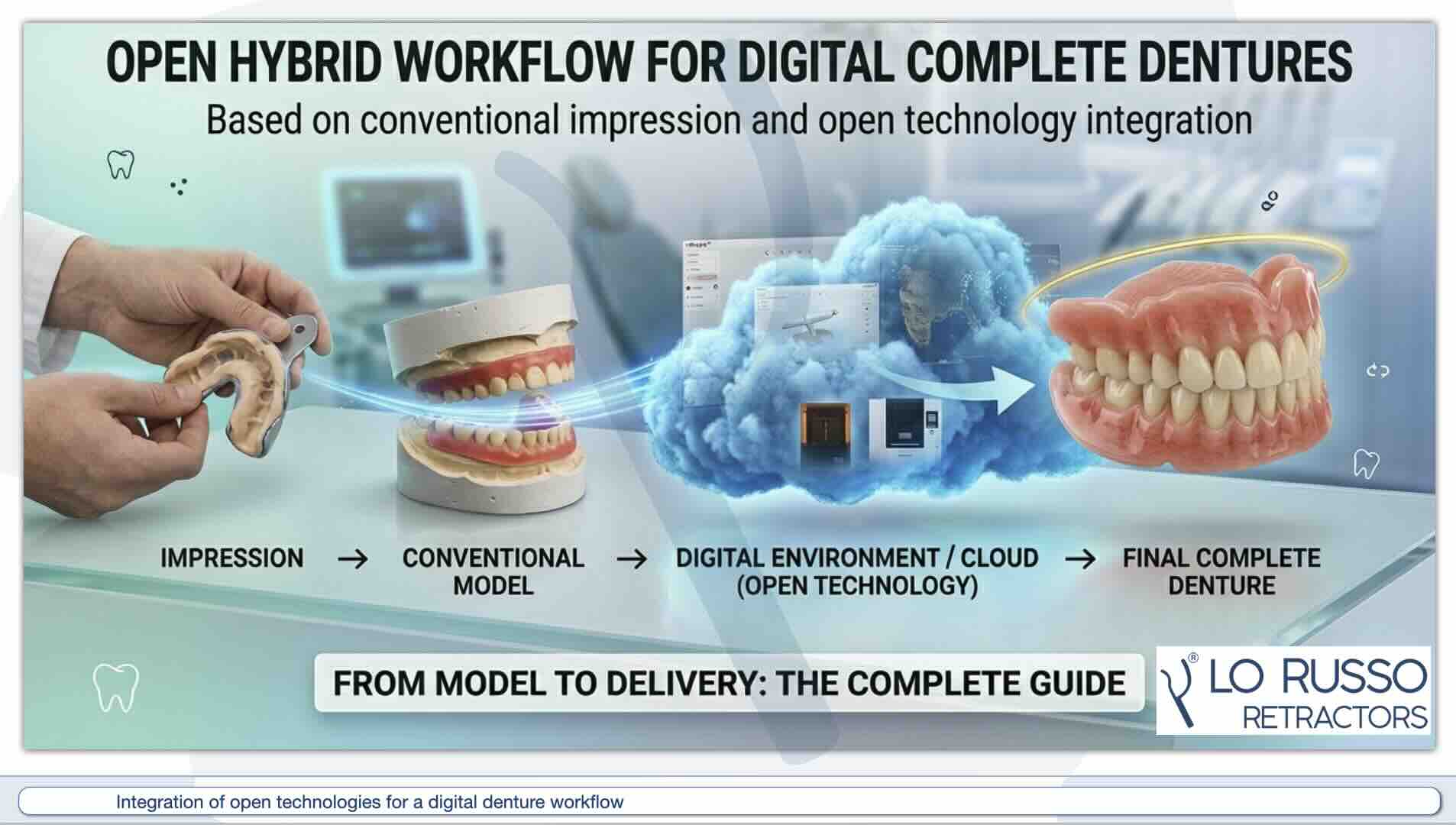
Complete digitization in removable prosthetics has made rapid progress. Today, the integration of CAD/CAM technologies allows for the complete digitalization of the production process. The clinical advantages are numerous (for example: better retention, improved mechanical properties of materials, reduction in chair time).
However, many closed commercial systems require proprietary equipment, valleys, or materials, limiting the integration between scanners, software, and production equipment (milling machines or 3D printers).
The Clinical and Laboratory Protocol: Step by Step
Preliminary Phases and Anatomical Impressions
The workflow begins traditionally with:
Anatomical Impression: Anatomical impressions of the edentulous arches are taken in alginate.
Model Scanning: The models are cast in plaster and an extraoral scan is performed using a scanner (either a desktop scanner or an intraoral scanner can be used) that can export the scan files in STL format.
CAD Design of Individual Impression Trays
Design of Impression Trays: Using CAD software (3Shape Dental System), individual impression trays for the final impression are designed.
3D Printing of Impression Trays: The STL files are sent to a 3D printer for the rapid fabrication of impression trays in thermoplastic material.
Recording Intermaxillary Relations and Alignment of the Wax Rims
Final Impressions and Occlusion Bases
Final Impression: The precision functional impression is made using polyether.
Scanning of Final Models:The final models are cast in plaster and digitized through scanning. It is obviously possible to scan the impressions directly without going through the development of the models.
Design of Occlusion Bases:The occlusion bases are designed on the digitized final models.
Printing the Bases and Clinical Flow: The bases are 3D printed and the clinician applies the hard wax for the definitive bite rims.
Recording Maxillary Relations and Virtual Facebow
Clinical Adjustment: The clinician records the vertical dimension, occlusal plane, and lip support by adjusting the wax rims on the patient.
Recording Intermaxillary Relations: Intermaxillary relations are recorded. The wax rims are secured in the mouth with appropriate recording material.
Scanning of the Centric Relation: The final models are positioned in the blocked occlusion valleys. A 3D scan of the buccal aspect of the single block is performed to transfer the exact spatial position and intermaxillary relationships to the CAD.
CAD Design of the Prosthesis and Clinical Fitting
Digital Total Prosthesis Modeling
Alignment in CAD Software: In the design module, the final models and the scan of the occlusion valleys are imported. The alignment is done using the 3-point method.
Mounting Teeth and Flange: The prosthetic protected is defined in the CAD design environment.
Clinical Validation with the Try-in Prosthesis
Printing the Try-in Prosthesis: To verify the fit of the digital prosthesis and the accuracy of occlusion before final production, a monoblock try-in prosthesis is 3D printed.
Intraoral Evaluation: The prosthesis is tested try-inin the mouth to assess aesthetics, phonetics, vertical dimension, and base fitting. At this stage, it is still possible to make changes in the software without wasting final materials.
Final Production: Milling and Assembly
CAM and Milling of the Prosthetic Base
CAM Setup: The final validated STL files are imported into the CAM software.
CNC Milling: The prosthetic base is milled from a 25 mm high density PMMA disc (using a 5-axis milling machine). The milled base ensures excellent mechanical properties and absence of porosity.
Bonding of Teeth and Finalization
Assembly: The commercial teeth selected in the CAD design are positioned and bonded into the wells of the milled base using a methacrylate-based bonding agent.
Finishing: The standard finishing and polishing of the prosthesis is carried out, ready for delivery to the patient.
Conclusion
A completely digital protocol offers multiple advantages. The benefits can be further enhanced if the digitalization process includes the use of intraoral scanning of edentulous arches; the fully digital workflow based on intraoral scanning represents a current and very significant evolution in removable prosthetics.
It allows for the simplification of the process, increasing predictability and improving quality, reducing time and costs.
The replacement of conventional impressions with intraoral scanning has relevant conceptual and practical implications.
Do you want to apply this and other protocols in a structured way? We are preparing complete pathways with techniques, real cases, and step-by-step clinical workflows.
If you want to go deeper
To fully understand the advantages of digital protocols for removable complete dentures, delve into these key aspects:
- Intraoral Scanning vs Conventional Impressions in Edentulous: Advantages, Limitations, and Clinical Indications
- Errors in intraoral scanning of edentulous arches
- Maxillary vs Mandibular Intraoral Scanning in Edentulous: Clinical Differences and Operational Strategies
- How to stabilize tissues in intraoral scanning
- Step-by-step workflow for scanning edentulous areas
- Trueness of intraoral scanning vs conventional impression of edentulous arches
- How intraoral scan quality affects prosthetic fitting
Continue your clinical journey
Deepen clinical knowledge
Explore scientific articles, clinical insights, and the main challenges in intraoral scanning of edentulous arches.
Apply validated protocols
Follow step-by-step workflows to achieve predictable results in intraoral scanning and digital prosthetics.
Access courses and training
Develop advanced clinical skills with structured training paths and practical tutorials.