Introduction
In the digital prosthetic rehabilitation of edentulous patients, the quality of the intraoral scan is one of the main factors influencing the fit of the final prosthesis.
A seemingly complete scan can indeed be clinically inadequate if it has errors in the recording of soft tissues or geometric distortions.
Understanding the relationship between scan quality and prosthetic fit is essential for achieving predictable results.
Why is scan quality critical?
The digital prosthesis is designed directly on the surface acquired through scanning.
This means that:
every error in the scan is transferred to the CAD design
every geometric distortion is replicated in the final prosthesis
every recorded tissue instability affects the clinical fitting
👉 In digital, the quality of the output cannot exceed that of the input.
Optimize the control of factors that ensure a higher quality intraoral scan (input)!
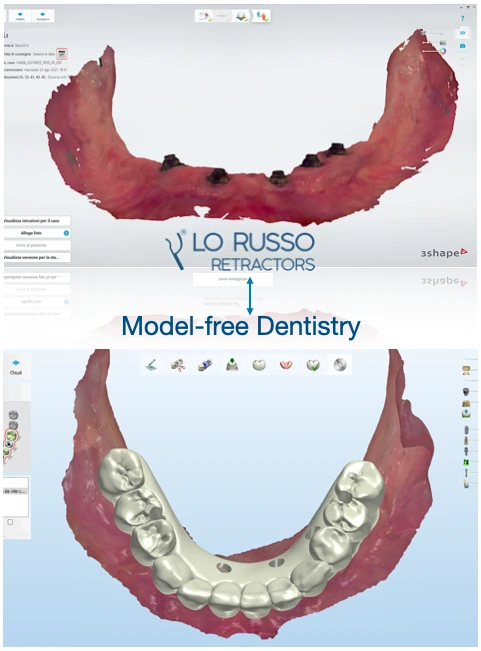
Main scanning defects and errors that compromise prosthetic fit
Cumulative geometric distortions
Stitching errors or non-optimal scanning paths can generate:
progressive deformations of the arch
alterations of the overall shape
occlusal or basal mismatches
Unstable recording of soft tissues
If the tissues are acquired under uncontrolled conditions:
they may be recorded in an altered position
they may change shape between scanning and clinical function
they reduce the repeatability of the result
Incomplete scanning of functional areas
The omission of important areas can compromise:
the extension of the prosthetic base
support and stability
retention of the final prosthesis
Clinical Impact on the Final Result
An insufficient quality scan can cause:
Poor basal fit
Disadaptation of the internal surface of the prosthesis.
Prosthetic instability
Loss of support and stability during function.
Need for post-production corrections
Rebasing, touch-ups, or remakes.
What Factors Improve Scan Quality?
Complete accessibility of the operating field
The scanner must be able to reach all relevant anatomical areas.
Stabilization of soft tissues
The tissues must be kept in a stable position throughout the acquisition.
Correct scanning strategy
The scanning path must minimize:
stitching error
loss of tracking
accumulation of distortions
Scanner suitable for the clinical case
Not all scanners offer the same performance on large surfaces and soft tissues.
Quality of Scanning and Predictability of the Digital Workflow
A digital workflow is truly predictable only if:
the initial scan is accurate
the tissues are properly registered
the functional anatomical areas are complete
the dataset is stable and repeatable
👉 The accuracy of the final prosthesis directly depends on the quality of the initial registration.
Conclusions
The quality of the intraoral scan is one of the most critical factors for the success of digital prosthetics in edentulous patients.
In summary:
an inaccurate scan directly compromises the prosthetic fit
the issue is not only technological but primarily clinical
access, tissue stability, and acquisition strategy determine the final outcome
👉 Improving the quality of the scan means directly improving the fit and predictability of the digital prosthesis.
Do you want to improve the quality of your intraoral scans and achieve more accurate and predictable digital prosthetics?
Discover the system designed to stabilize tissues and facilitate the scanning of edentulous arches.