The point that many underestimate
When scanning edentulous arches intraorally, the choice of retraction system is crucial.
Yet, in clinical practice, attention often focuses on secondary aspects:
- number of components
- configuration options
- modularity
👉 The real point is another:
the actual operational configuration
- How many steps are needed before starting?
- Is the system immediately usable?
- Does the result depend on the instrument or the operator?
These are the variables that determine clinical effectiveness.
How are retraction systems structured?
To understand the operational differences, it is necessary to start from the structure of the system. Practically, retraction systems are divided into two categories:
Monoblock systems (ready to use)
These are devices made of a single element, possibly available in multiple sizes to adapt to anatomical variability. They are characterized by:
- immediate use
- no assembly phase
- predefined configuration
👉 The tool is already in its final operational form.
👉 The presence of multiple sizes does not introduce operational complexity, but represents a mode of adaptation. In fact, it should be considered that:
- a single size is often sufficient for most cases
- additional measures are needed to optimize specific situations
- the effectiveness of the system does not depend on the number of available variants
👉 It is therefore an adaptation option, not a structural requirement for operation.
Modular systems
They consist of multiple separate elements (base structure + opening/closing mechanisms + various interchangeable inserts), whose operational configuration is built each time. They often arise with the intent to improve adaptability; however:
- they require assembly
- assembly requires selection of the desired insert and its correct positioning
- they allow for different possible configurations, but there is a possibility of inconsistencies in positioning
- the final shape depends on the assembly
- operational effectiveness also depends on the consistency and skill of the operator
👉 The intent is to cover multiple situations with a single configurable system.
However, this approach has an operational consequence:
- adaptation is no longer incorporated into the tool
- but becomes part of the usage process and the skill of the operator using the tool
👉 With an increase in the operational variables already analyzed (steps, decisions, stability).
Origin and evolution of systems
Retractable systems for intraoral scanning of edentulous arches do not originate as complex or modular systems.
They originate as monoblock tools.
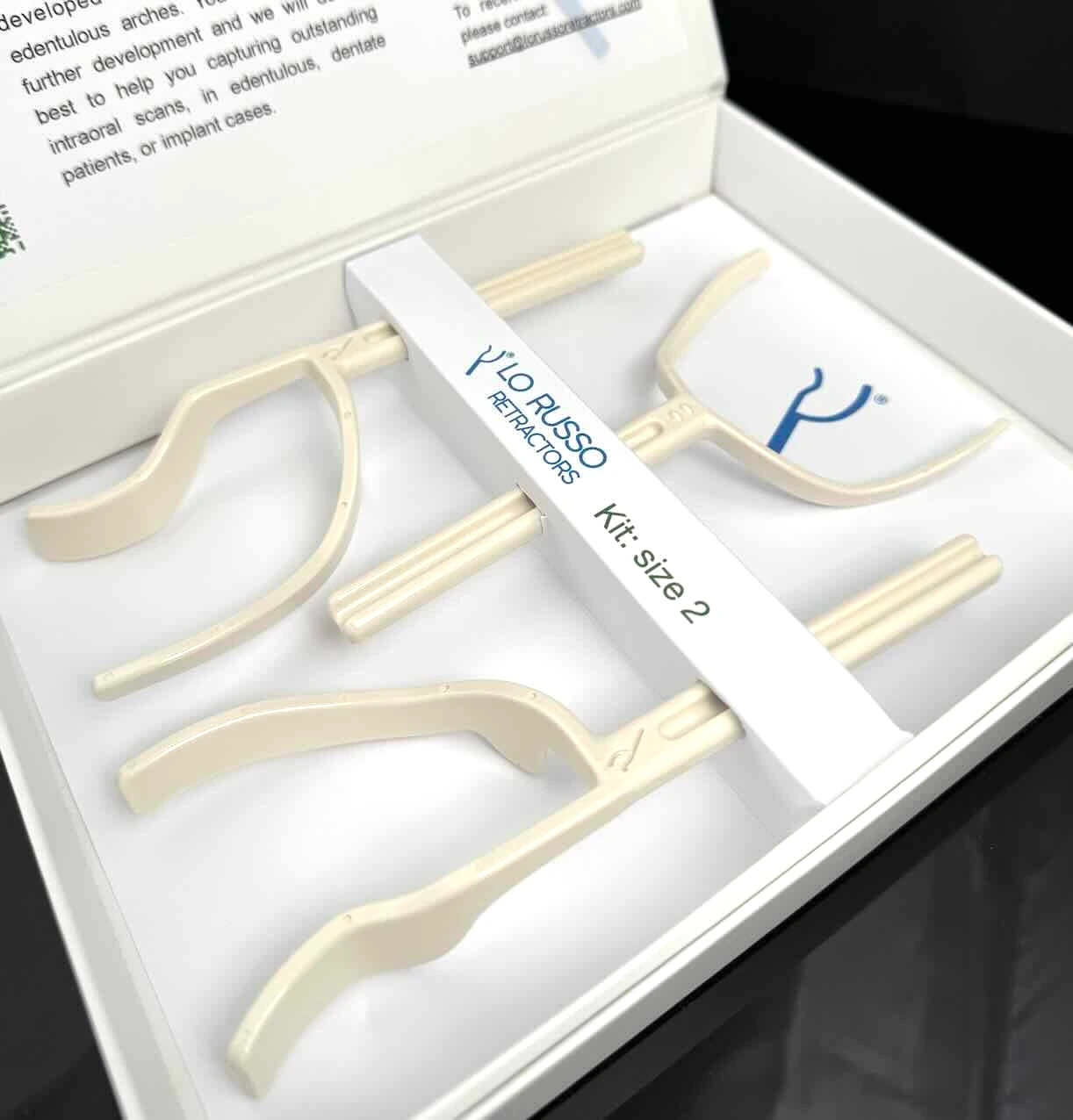
👉 The reason is functional:
- immediate access
- tissue stability
- reduction of operational variables
In this context, the single configuration represents the most direct and effective solution.
Theoretical adaptability ≠ real operational effectiveness
With the spread of intraoral scanning, systems have been introduced that adopt a different approach to managing retraction.
These systems take up shapes and functional principles already present in monoblock devices, but implement them through:
- greater number of components
- configuration options
- modular structure
- theoretical adaptability (related to configuration possibilities)
- real operational effectiveness (related to how the system works in practice)
- immediate access
- constant stability
- reduction of variables in the workflow
👉 The stated goal is to increase adaptability to different clinical conditions.
👉 However, it is important to distinguish between:
👉 In this context, monoblock systems remain the operational reference,
as they are designed to ensure:
What really changes in clinical practice
The structural difference has direct consequences on the workflow.
Number of operational steps
- Monoblock→ immediate use
- Modular→ preparation + assembly
👉 Each additional step introduces time and the possibility of error.
Stability and repeatability
- Monoblock→ consistent behavior
- Modular→ depends on the configuration and the operator
👉 Stability can become a variable.
Operator dependence
- Monoblock→ instrument-driven result
- Modular→ operator-influenced result
👉 Increases variability between cases and operators.
Continuity during the procedure
- Monoblock→ stable retraction over time
- Modular→ possible variations during use
👉 Direct impact on scan quality.
Management and maintenance
Monoblock
- no connection points
- simple cleaning
- limited wear
Modular
- interfaces between components
- greater cleaning complexity
- wear of connections and loss of component stability
Operational comparison between retraction systems
| Parameter | Monoblock system (ready to use) | Composable system (modular) |
|---|---|---|
| Initial configuration | Immediate | Requires assembly |
| Number of steps | Minimum | Greater |
| Preparation time | Reduced | Variable |
| Stability during the procedure | Constant | Depends on the configuration |
| Repeatability | High | Variable |
| Operator dependence | Reduced | Greater |
| Retrieval continuity | Guaranteed | May vary |
| Instrument management | Simple | More complex |
| Cleaning and maintenance | Linear | More articulated (interfaces) |
| Operational variables | Limited | Greater |
A point often overlooked
The difference between the two configurations is related to the number of variables introduced into the workflow. Increasing the number of additional elements (component, step, configuration) increases operational complexity; this does not equate to improving clinical performance.
In practice:
- each additional element introduces a variable
- each configuration requires a decision
- each step can influence the outcome
👉 In clinical workflows, reducing variables is a key factor.
👉 Reducing these variables means improving:
- control
- predictability
- clinical efficiency
The key point: operational configuration
The effectiveness of a system does not depend on how many theoretical options it offers, but on how it works under real conditions.
👉 An effective system is one that:
- requires fewer steps
- reduces operational decisions
- ensures consistent conditions
- it does not depend on the skill or consistency of the operator (ability to maintain the same level of opening/closing)
A practical selection criterion
For a rational evaluation:
- consider the number of steps before use
- check if the configuration is immediate or constructed by selecting pieces to be assembled in specific positions to be recognized and respected
- evaluate the dependence on the operator
👉 In a clinical setting, complexity is only justified when it brings a concrete benefit in real operational conditions.
Conclusions
In the context of intraoral scanning of edentulous patients, the difference between systems lies in the real possibility of managing soft tissues simply and independently of the operator:
- systems that require configuration → introduce variability
- ready-to-use systems → reduce variables
👉 When access and stability are directly guaranteed, workflow becomes simpler and results more predictable. These characteristics fall more within the realm of monoblock systems, which remain the operational benchmark.
To evaluate the configuration most suitable for your practice:
👉 Discover the original monobloc retraction system
👉 Contact us for a technical consultation
If you want to go deeper
To understand how these variables actually influence intraoral scanning, delve into these key aspects:
- Errors in intraoral scanning of edentulous arches
- Why does intraoral scanning of edentulous patients fail?
- How to stabilize tissues in intraoral scanning
- Step-by-step edentulous scanning workflow
- How to improve the accuracy of full-arch scans
- How the quality of the scan affects prosthetic fitting
Continue your clinical journey
Deepen your clinical knowledge
Explore scientific articles, clinical insights, and the main challenges in intraoral scanning of edentulous arches.
Apply validated protocols
Follow step-by-step workflows to achieve predictable results in intraoral scanning and digital prosthetics.
Access courses and training
Develop advanced clinical skills with structured training paths and practical tutorials.