When developing an efficient digital workflow, instrument selection is never a matter of purely aesthetics or price. It's a matter of clinical predictability. When it comes to soft tissue retraction for intraoral scanning (IOS), especially in the complex challenges of edentulous arches, crucial questions often arise: "What is the ideal size for my practice?", "How do I navigate the various available sizes?", and "Why should I invest in a complete set?"
This guide aims to provide absolute clarity on the scientific criteria for choosing sizes and the clinical rationale that makes original monoblock devices the only true ally for eliminating operational friction at the chair, maximizing return on investment thanks to unprecedented versatility.
📐 Scientific Guidelines for Size Selection
Patient anatomy is inherently variable. For this reason, the LO RUSSO RETRACTORS® system has been engineered with three specific setup options, calibrated to the actual needs and workload of the dental practice:
[ SINGLE UNIT ]: Monolithic kit with 3 retractors (1 upper + 2 lower) in a single size;
[ CORE SET ] : The ultimate setup to optimize daily clinical routine;
[ ADVANCED SET ]: Maximum operational readiness for complex and pediatric anatomies.
1️⃣ Single Unit (Single Size Kit) – Targeted Integration
This is not a single piece, but a complete operating kit consisting of three monolithic retractors (one specifically for the upper arch and two for the lower arch) in one size. These monolithic instruments were designed to allow for maximum workflow customization, optimizing the user experience and comfort in managing specific clinical needs.
It is the ideal choice for the practice that wants to test the effectiveness of the protocol on a specific type of patient, or for those who already have a set and need to duplicate a specific size to optimize sterilization cycle times in the autoclave without ever stopping the chair.
🧭 Guide to Choosing the Ideal Size
To navigate the purchase of the Single Unit or to understand which size to take from the sterile tray to optimize intervention times, here is the official anatomical rationale derived directly from our clinical protocols:
🔹 Size — (Ultra Small)
Clinical Target:Optimizes user experience and patient comfort in the presence of severely resorbed edentulous ridges.
Instructions for Use:Ideal solution for pediatric cases, orthodontic treatments, and very small arches. Includes 3 anatomically oriented retractors for managing the entire arch.
🔹 Size 0 (Small - Medium)
Clinical Target:Optimizes user experience and patient comfort in standard anatomies of young and adults.
Instructions for Use:It is the fundamental size and amust-haveessential for daily clinical workflow. Developed to ensure management of the entire arch in cases of total edentulism as well as in situations of partial dentition or hybrid cases.
🔹 Size 1 (Medium - Large)
Clinical Target:Optimizes user experience and comfort in standard or larger adult anatomies.
Instructions for Use:Represents another key tool for the daily clinical routine of the practice. Ideal for achieving significant retraction of soft tissues on wide arches, ensuring stability and precision on both edentulous arches and hybrid or partially dentate cases.
🔹 Size 2 (Extra Large)
Clinical Target:Specifically intended for large adult dental arches.
Instructions for Use:Alternative configuration developed to meet specific clinical requirements. Essential for managing XL anatomies.
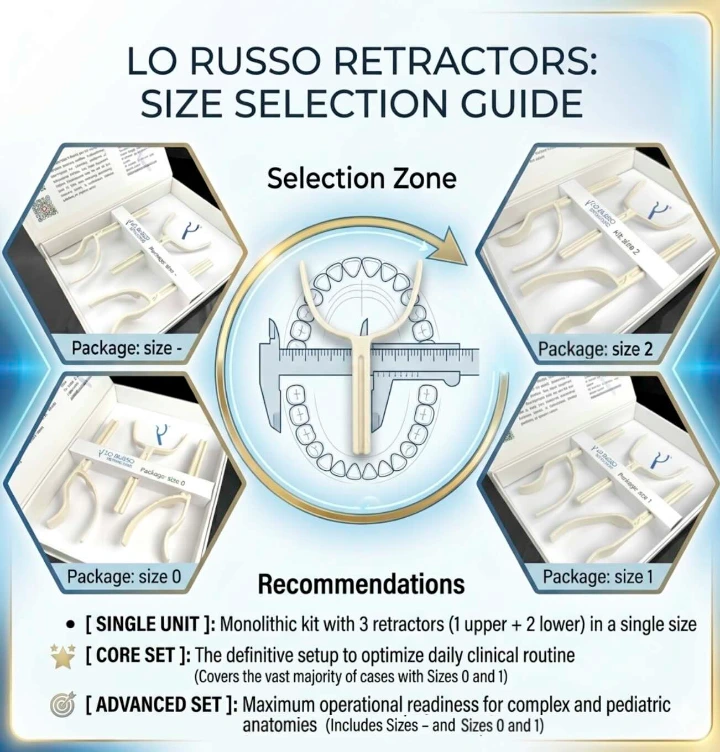
2️⃣ Core Set (Sizes: 0 and 1) – The Most Efficient Solution for the Practice
It is the definitive setup to streamline the daily clinical routine (The definitive setup to streamline your daily clinical routine). It includes two complete kits (Sizes: 0 and 1, for a total of 6 monoblock pieces) and represents the most advantageous and convenient solution for standard dental practice (The most cost-effective solution for your practice). It offers complete anatomical coverage for all standard and/or wide arches of young and adult patients (Complete anatomical coverage for all standard, young, and wide adult arches).
3️⃣ Advanced Set (Sizes: -, 0, 1) – Maximum Operational Readiness
The most complete setup (9 total pieces) that introduces theSize - (Minus). This package extends the clinical capabilities of the practice to complex or specialized scenarios:
Pediatric Cases: Perfect for space management and soft tissue control in small patients.
Advanced Orthodontic Treatments: Provides the necessary isolation, visual access, and stability for direct and indirect bonding procedures, ligation, as well as intraoral scanning.
Complex Crestal Anatomies: Essential in the presence of significant bone resorption, thin ridges, or micrognathia, where standard-sized retractors would be dimensionally excessive for the patient's fornix.
👉 [Visit the Official Shop and Configure the Setup for Your Practice]
🔬 The Monolithic Dogma: Why the Unique Rigid Shape Drives the Outcome
When designing medical devices for digital dentistry, geometric stability is everything. A digital workflow that strives for pinpoint accuracy cannot tolerate micro-movements or structural flexures during image capture. For this reason, LO RUSSO RETRACTORS has chosen the path of absolute monolithic design.
Each instrument is printed as a single solid piece, without joints or moving parts. The clinical advantages of this engineering approach are structural:
Instrument-Guided Outcome:The force exerted on the tissues is pre-calculated and determined by the physics of the instrument itself, not by the manual sensitivity of the operator or the degree of tightening of secondary components. This eliminates variability between different operators in the same practice.
Continuity and Total Hygiene:The absence of gaps, interlocking interfaces, or threads eliminates the root causes of biological debris accumulation. Autoclave sterilization treats a single body, ensuring maximum safety and a durability over time that is incomparable to assembled instruments.
Elimination of Downtime:The instrument is taken from the sterile tray and placed in the mouth. Zero intermediate steps, zero decisions on which piece to mount, zero risks of component detachment during intraoral scanning.
🎓 Workflow note: In the clinical setting, real efficiency is linked to the subtraction of variables. The fewer elements manipulated before treatment, the more repeatable and predictable the final result becomes. (If you'd like to learn more about the impact of structural architectures on the digital workflow, read our technical article on the Comparison of Off-the-Shelf Retraction Systems and Modular Systems.)
💎 Multidisciplinary Versatility and ROI: The Economic Value of a Complete Set
Limiting this system's use to optical impressions only means exploiting only a fraction of its potential. The true return on investment (ROI) lies in its daily clinical utility in every branch of dentistry, where tissue stability and patient control make the difference between a smooth workflow and a stressful procedure.
It is precisely in theReturn on Investment (ROI)related to chair time that the answer to the question lies"Why invest in a complete set like the Core Set or the Advanced Set instead of purchasing a single size?"
In calculating the operating costs of a dental practice, the most burdensome factor is operational time. Having to interrupt a digital procedure because the patient's tongue invades the field, or being forced to compromise on precision due to a too-narrow vestibule, generates a heavy hidden cost in terms of lost minutes and impressions that need to be redone.
Having the entire range of sizes on the sterile tray transforms the system into auniversal assistant fixed to the chair, usable throughout the entire clinical day in multiple branches:
1. Optimization of Intraoral Scanning (IOS)
In edentulous arches, the collapse of the soft tissues and tongue makes aligning the scanner frames extremely challenging. The Lo Russo Retractors® system stabilizes and retracts the mobile tissues, allowing for smooth, rapid readings free of motion artifacts.
2. Orthodontics and Bracket Placement
Field isolation and moisture control are critical during bracket bonding. The monoblock design ensures symmetrical vestibular and lingual retraction, controlling involuntary movements of the patient's tongue, lips, and cheeks, thus preventing saliva from contaminating the etched surfaces ready for adhesion (utilizing the targeted action of the Measure — or Measure 0 depending on the subject's age).
3. Fixed Prosthetics and Marginal Preparations
During the delicate finishing phase of prosthetic margins or the placement/removal of gingival retraction cords, having a completely open and stable field of view allows the dentist to operate with maximum accuracy, without the interference of hypertonic cheeks or lips.
4. Surgical and Implant Procedures
Ensuring direct, symmetrical vestibular and lingual visual access with one hand improves work ergonomics and patient comfort.
🛒 Conclusions: Which Configuration to Choose?
The choice of the ideal setup depends exclusively on the operational goals of your facility:
The Core Set represents the fundamental equipment for a practice focused on prosthetics and standard digital workflows, ensuring maximum efficiency in daily routine cases, and offering the perfect clinical and economic balance for routine with young and adult patients.
The Advanced Set is the preferred choice for multidisciplinary clinics, orthodontic departments, or specialists who frequently face challenges with complex anatomies, geriatric patients with significant resorption, or pediatric cases, ensuring total operational readiness.
The Single Unit formulas, finally, offer maximum flexibility to expand your range of measures over time or integrate specific high-specialization sizes (such as the Measure - for pediatric/orthodontic purposes), always benefiting from free express shipping.
Choose the scientific certainty of an original and patented monoblock system.
👉 [Visit the Official Shop and Configure the Setup for Your Practice]
If you want to go deeper
To understand more deeply how the choice of the retraction system is the keystone in intraoral scanning, especially of edentulous arches, delve into these key aspects:
- Common errors in intraoral scanning of edentulous arches
- Why does intraoral scanning of edentulous areas fail?
- How to stabilize tissues in intraoral scanning
- Step-by-step edentulous scanning workflow
- How to improve the accuracy of full-arch scans
- How scan quality affects prosthetic fitting
Continue your clinical journey
Deepen your clinical knowledge
Explore scientific articles, clinical insights, and the main challenges in intraoral scanning of edentulous arches.
Apply validated protocols
Follow step-by-step workflows to achieve predictable results in intraoral scanning and digital prosthetics.
Access courses and training
Develop advanced clinical skills with structured training paths and practical tutorials.