Why a new digital protocol is needed
Removable dental prostheses represent a fundamental solution for the rehabilitation of edentulous patients, but traditional workflows have significant limitations: numerous clinical stages, intensive use of materials, operator-dependent variability, and long times.
The conventional workflow is based on physical impressions, plaster models, and multiple intermediate steps, with a significant impact in terms of time, costs, and standardization of results.
The limitation of current digital systems
CAD-CAM technologies have introduced important innovations, but in most cases, digitalization only pertains to the laboratory. The clinical phase remains analog and requires the conversion of impressions and models into digital data.
This hybrid approach reduces efficiency and keeps the complexity of the process high.
The key step: intraoral scanning
A truly digital workflow begins when the impression is natively digital.
Intraoral scanning allows for the direct acquisition of the morphology of the arches in the form of files, eliminating impression materials and physical models, and enabling immediate integration into the digital flow.
Do you want to understand when and why intraoral scanning in edentulous patients really works?
Discover problems, limitations, and clinical strategies in the comprehensive guides
The critical issues to overcome
The use of intraoral scanning in edentulous patients is limited by some critical issues:
- instability of the mucosal tissues
- difficulty in complete acquisition
- absence of protocols for interarch relationships
- difficulty in transferring aesthetic and functional parameters
Without a solution to these aspects, a fully digital workflow is not achievable.
Learn about the most common mistakes and how to avoid them in clinical practice
Objective of the protocol
The protocol based on intraoral scans aims to enable a fully digital workflow through:
- predictable intraoral scans even in total edentulism
- correct registration of interarch relationships
- transfer of aesthetic parameters
- integration with CAD-CAM technologies
- elimination of impressions and physical models
Watch the workflow demonstration video created by our clinical partner:
The intraoral scans shown in the video were made with the Lo Russo Retractors® retraction system.
Workflow structure
The process is divided into two main phases.
The clinical phase includes the acquisition of anatomical and functional data through intraoral scanning and dedicated recordings.
The digital phase includes processing, CAD design, and CAM production of the prosthesis.
Do you want to apply this protocol in practice?
Deepen operational strategies and step-by-step workflows
Phases of the Clinical and Laboratory Protocol: Step-by-Step
The success of this workflow is based on the precise alternation and synergy between chairside sessions and digital processing within the dental laboratory. Below is a detailed operational sequence.
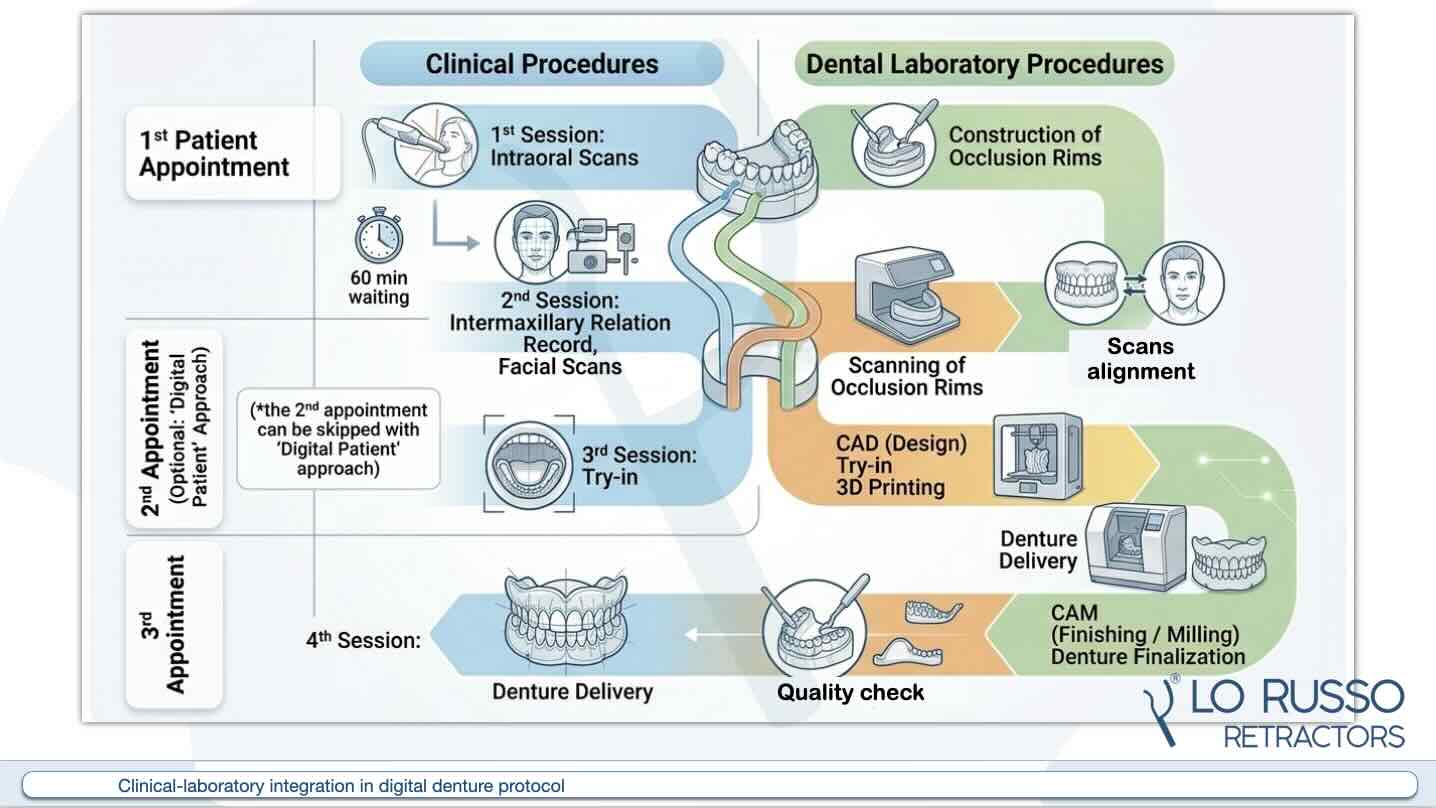
1. First Clinical Session: Acquisition of Intraoral Scans
The workflow begins with the intraoral scanning of the edentulous archesof the patient. This is performed using dedicated strategies and auxiliary tools that allow fors tabilizing the tissues, improving visibility and guiding the movement of the scanner, increasing accuracy. The three-dimensional files generated are processed and exported directly to the CAD design software of the dental laboratory, eliminating the need for physical impressions and plaster models, which:
- reduces costs
- shortens time
- avoids transferring potentially contaminated or infected objects
- improves the standardization of the workflow
2. First Laboratory Phase: Modeling and Printing of Registration Bases
In a CAD environment, the plates for the manufacturing bases of the occlusion valleys are designed. To ensure perfect stability, in the software, the space for the impression material (which will not be there) is set to zero, allowing the bases to fit perfectly to the mucosa. The generated files are sent to a 3D printer for the production of bases in biocompatible polymer, on which the technician will apply the wax valleys for the subsequent clinical phase.
3. Second Clinical Session: Intermaxillary Registration and Facial Scanning
During this session, the clinician performs the registration of maxillomandibular relationships on the patient. The fundamental parameters are detected and validated: vertical dimension of occlusion, occlusal plane, lip support, length of the maxillary incisors, midline, and smile line. Once the repeatable centric relation position is obtained, the valleys are locked with a registration material.
At the same time, with the valleys inserted and the patient in a smiling position, the facial scan (middle third, lower third, and possibly full face) is acquired to capture the aesthetic parameters.
4. Digitalization of the Occlusion Valleys
Once clinically stabilized, the occlusion valleys must be converted into digital data. This operation can be performed directly at the chair using an intraoral scanner, or in the laboratory using a high-resolution desktop scanner.
5. Second Laboratory Phase: Alignment and CAD Design of the Prosthesis
The laboratory imports into the modeling software the scans of the edentulous arches, the occlusal valleys, and the aesthetic data of the patient's face, proceeding with their alignment.
Through the overlay of facial scans, the "digital patient" in 3D is generated: this allows for the optimization of the positioning and individual mounting of the teeth in perfect harmony with the aesthetic and functional profile of the face.
6. Prototype Production for Clinical Try-in
Based on the approved design, the laboratory creates a rapid prototype of the trial prosthesis. A 3D printing technology using a biocompatible polymer and fused deposition modeling is employed. This solution represents an efficient and economically sustainable option to evaluate function and overall aesthetics before final production.
7. Third Clinical Session: Evaluation of the Trial Prosthesis
The trial prosthesis is tested in the patient's mouth to validate fit, phonetics, and aesthetics. Thanks to the accuracy of the preliminary facial scan, the need for modifications is drastically reduced.
However, any corrections to the tooth mounting can be performed directly in the chair: since it is a thermoplastic polymer, the teeth of the prototype can be detached with a heated tool and repositioned in the correct occlusion using wax.
8. Third Laboratory Phase: Optimization and Final CAM Production
In the event that clinical modifications have been made to the prototype, the laboratory reopens the design file to integrate the new data, using the scan of the modified prosthesis as a precision geometric guide.
Once the final design is validated, the CAD files for the prosthetic base and teeth are sent to the CAM software for final production. The base is milled from a high-density polymethyl methacrylate disc for complete dentures, while the teeth are made from a multilayer polymer block. If chosen during the CAD phase, there is the option to use prefabricated commercial teeth.
9. Assembly and Finalization in the Laboratory
The milled teeth are joined to the prosthetic base using a fast-curing acrylic resin, strictly following the manufacturer's bonding protocols to ensure maximum long-term structural strength.
10. Fourth Clinical Session: Delivery of the Prosthesis
The final digital complete denture is placed in the patient's mouth. Final checks for stability, retention, and occlusal balance are performed, thus completing the workflow.
Advantages of the digital workflow
For the patient, this approach reduces the number of appointments, improves comfort, and eliminates invasive procedures such as traditional impressions.
For the dental practice, it allows for greater efficiency, cost reduction, and standardization of procedures.
Overall, it promotes access to care, reduces environmental impact, and improves the quality of outcomes.
Conclusion
A completely digital protocol based on intraoral scanning represents a significant evolution in removable prosthetics.
The quality of the result also depends on the tools used.
Discover which technologies really make a difference
It simplifies the process, increases predictability, and improves quality while reducing time and costs.
If you want to go deeper
To fully understand the intraoral scanning of edentulous arches, explore these key aspects:
- Errors in intraoral scanning of edentulous arches
- Maxillary vs Mandibular Intraoral Scanning in Edentulous Patients: Clinical Differences and Operational Strategies
- How to stabilize tissues during intraoral scanning
- Step-by-step edentulous scanning workflow
- Intraoral Scanning vs Conventional Impression in Edentulous Patients: Advantages, Limitations, and Clinical Indications
- Trueness in intraoral scanning vs. conventional impression: are we measuring something that doesn't exist?
- How scan quality affects prosthetic fitting
Continue your clinical journey
Deepen your clinical knowledge
Explore scientific articles, clinical insights, and the main challenges in the intraoral scanning of edentulous arches.
Apply validated protocols
Follow step-by-step workflows to achieve predictable results in intraoral scanning and digital prosthetics.
Access courses and training
Develop advanced clinical skills with structured training paths and practical tutorials.