Introduction
In the rehabilitation of edentulous arches, one of the most frequently asked questions is:
Can intraoral scanning really replace conventional impressions?
Many clinicians perceive differences between the two techniques and often interpret them as errors or limitations of digital technology.
In reality, intraoral scanning and traditional impressionsdo not record the same biological reality..
Understanding this difference is the first step to:
- avoiding clinical errors
- improving predictability
- truly leveraging the potential of the digital workflow.
Fundamental Biological Difference: Mucostatic vs Mucocompressive
Direct comparison between scanning and impressions
| Characteristic | Intraoral scanning | Conventional impression |
|---|---|---|
| Tissue registration | Mucostatic | Mucocompressive / selective |
| Pressure on tissues | Minimal | Variable |
| Reproducibility | High (digital) | Operator-dependent |
| Patient comfort | High | Reduced |
| Workflow | Digital | Analog |
Because the differences between scanning and impressions are not necessarily errors
Discover in detail the differences between a mucostatic or mucocompressive impression in digital prosthetics? Explore the topic in the complete dedicated course.
Advantages of intraoral scanning in edentulous patients
Advantages of conventional impressions
Limits of intraoral scanning
To achieve reliable mucostatic registration through intraoral scanning, it is essential to ensure complete accessibility and stabilization of the soft tissues.
Discover the system designed to facilitate intraoral scanning of edentulous arches.
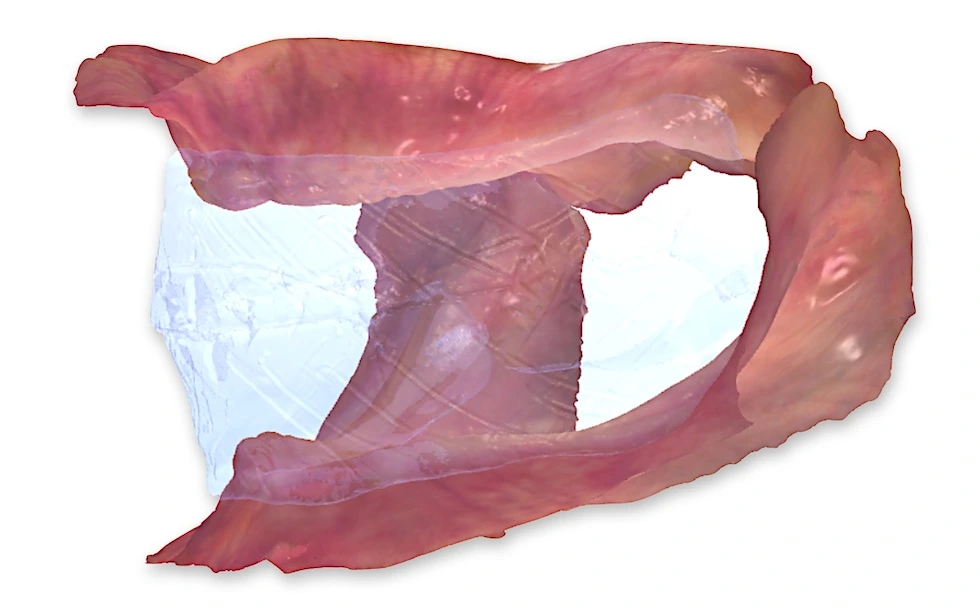
The real limitation of intraoral scanning in edentulous cases.
In most cases, the problem is not the scanner.
👉 It is the management of soft tissues.
If the tissues are not:
- stabilized
- properly retracted
- completely accessible
the scan becomes:
- incomplete
- not reproducible
- clinically unreliable
To solve the poor management of tissue retraction , clinicians should use specific edentulous retractors that ensure complete accessibility and stabilization of the soft tissues
👉 Improve tissue stability during scanning
to obtain reliable scans, it is essential to control the operating field.
➡️ Discover the system designed to improve accessibility and stability in edentulous patients:
Limitations of conventional impressions
Conventional impressions may have limitations related to:
When to prefer intraoral scanning
When conventional impressions may still be indicated
Conclusions
Intraoral scanning and conventional impressions are not direct alternatives, but tools based on different biological principles.
The real clinical difference is not the technology used, but:
👉 the ability to control soft tissues and the working field
When these conditions are managed correctly, intraoral scanning becomes a method:
- - reliable
- - predictable
- highly efficient