Introduction
The growing prevalence of digital workflows in removable and implant prosthetics has increasingly led to comparisons between intraoral scanning and conventional impressions in the management of completely edentulous patients.
Many clinicians wonder which of the two methods is more accurate, predictable, and clinically appropriate.
The correct answer is that these are not equivalent techniques measuring exactly the same thing: each approach records soft tissues according to different biological principles.
Understanding this difference is crucial for correctly interpreting clinical results.
Fundamental Biological Difference Between the Two Techniques
Intraoral scanning records soft tissues in mucostatic conditions.
This means that:
- tissues are recorded without significant compression
- the mucosa maintains its physiological shape at rest
- the acquired data reflects the natural morphology of the tissues
Conventional impressions, on the other hand, generally result in a mucocompressive or mucoselective registration, depending on:
- impression material used
- viscosity of the material
- impression technique adopted
- pressure applied by the clinician
Because the differences between scanning and impressions are not necessarily errors
Several clinical studies have demonstrated that discrepancies observed between intraoral scans and conventional impressions do not necessarily represent distortions or loss of accuracy.
In most cases, such differences simply reflect:
- the physiological resilience of soft tissues
- the different biological behavior of the mucosa under load
- the different philosophy of tissue registration
In other words:
a difference between the two methods does not automatically imply that one is less accurate than the other. Awareness of this and a thoughtful clinical evaluation are necessary to make the most of all the benefits offered by the technique best suited to meet the specific case requirements.
Discover in detail the differences between a mucostatic or mucocompressive impression in digital prosthetics? Explore the topic in the complete dedicated course.
Discover in detail the differences between a mucostatic or mucocompressive impression in digital prosthetics? Explore the topic in the complete dedicated course.
Advantages of intraoral scanning in edentulous patients
When performed under controlled clinical conditions, intraoral scanning offers numerous advantages:
- elimination of impression materials and physical models
- greater comfort for the patient
- high standardization of the process
- rapid data acquisition
- better integration with CAD/CAM software
Additionally, it allows for more efficient communication with the laboratory, and by avoiding the transfer of potentially contaminated objects, it reduces the risk of cross-infections.
Advantages of conventional impressions
The conventional impression still maintains some specific advantages:
- the ability to selectively modulate tissue compression
- operational familiarity for many clinicians
- established historical literature
Limits of intraoral scanning
Intraoral scanning may be less predictable in the presence of specific conditions and procedural errors:
- very mobile tissues
- reduced accessibility
- instability of peripheral tissues
- poor management of tissue retraction
- scanners not optimized for full arch soft tissue scanning
In such situations, the limitation is generally not technology, but rather clinical control. Indeed, by being able to consciously and effectively manage common errors in intraoral scanning of edentulous arches, the resulting scans are reliable and predictable.
To achieve reliable mucostatic registration through intraoral scanning, it is essential to ensure complete accessibility and stabilization of the soft tissues.
Discover the system designed to facilitate intraoral scanning of edentulous arches.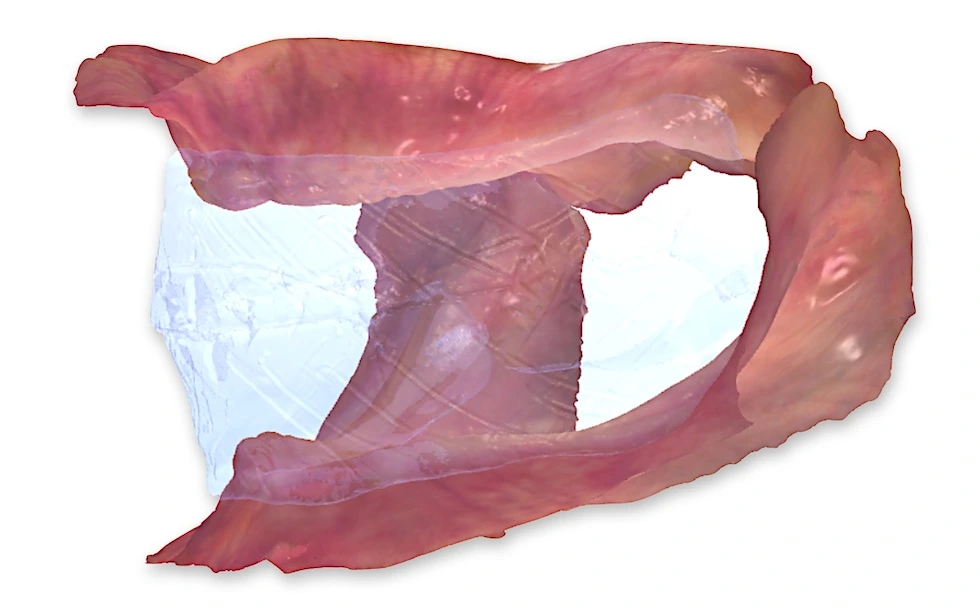
To achieve reliable mucostatic registration through intraoral scanning, it is essential to ensure complete accessibility and stabilization of the soft tissues.
Discover the system designed to facilitate intraoral scanning of edentulous arches.
Limitations of conventional impressions
Conventional impressions may have limitations related to:
- application of pressure on the tissues of the residual ridge that can have a biological effect on it, reducing its stability over time
- possible side effects related to hypersensitivity or allergies to impression materials
- patient discomfort and gagging during the impression-taking procedure
When to prefer intraoral scanning
Intraoral scanning is an excellent choice when:
- the scanning field is fully accessible
- maximum efficiency and standardization are desired
When conventional impressions may still be indicated
Conventional impressions may still be indicated when:
- a mucocompressive registration is deliberately desired
- the laboratory workflow is not digitized
Conclusions
Intraoral scanning and conventional impression taking should not be considered competing techniques in an absolute sense, but rather different tools with different biological principles.
When correctly performed under controlled clinical conditions, intraoral scanning of edentulous arches represents a method:
- reliable
- predictable
- clinically valid
The choice between digital and conventional workflow should therefore be based not on technological preconceptions, but on:
- biological treatment objectives
- clinical conditions of the patient
- ability to control soft tissues
- desired prosthetic workflow